Rohloff: why and how?
- Reliability
- Huge 526% gear range (any climb, any descent)
- Low maintenance costs
- Environmentally friendly
- German manufacturing
- Peace of mind: no risk of cross-chaining or dropping the chain, less cleaning to do
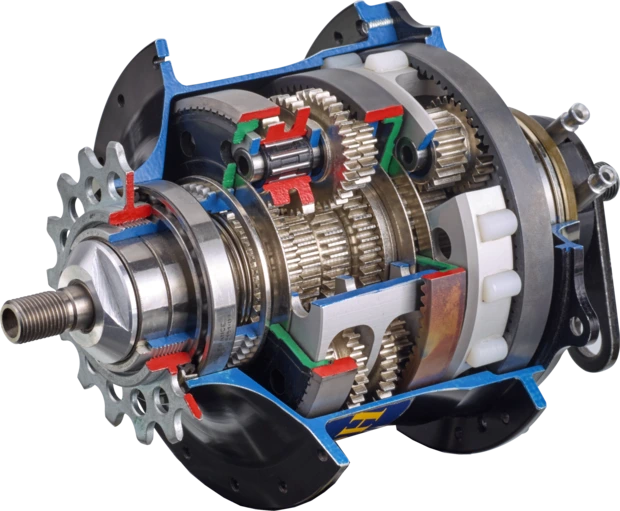
We are Rohloff dealers, meaning we can carry out conversions and service of your hub. As everywhere, the most complex repairs can only be done by sending the hub to Rohloff in Fuldatal, Germany; this way they come guaranteed.
Choosing a Rohloff means investing in peace of mind. We support you at every stage: from advice to conversion, including precise adjustments and personalised follow-up. Enjoy a reliable, durable solution tailored to the needs of the demanding cyclist.
Comparison
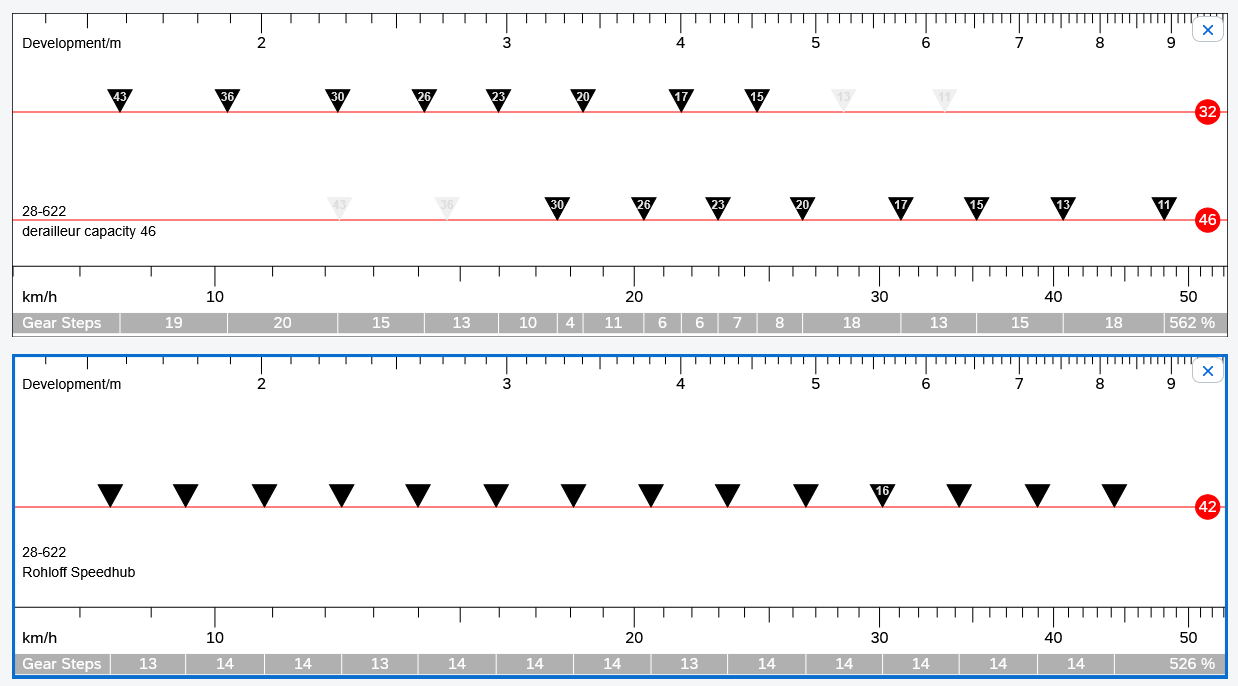
Above, the latest Cues 2 × 11-speed transmission in a setup specific to touring bikes (two chainrings of 32 and 46 teeth, and a large 11–45 cassette that pushes the derailleur's limits). This gives a 562% gear range: the "hardest" gear turns 562% more than the "easiest" one. It's a well-thought-out derailleur setup for touring and fairly reliable. Four gears are unusable due to cross-chaining. Two derailleurs, two shifters, more maintenance, but a lower initial investment.
Below, a Rohloff hub: 11 "real" gears, with more-than-even spacing that lets you optimise your cadence. The 526% gear range is practically equivalent. You can cover 300,000 km on the same Rohloff by keeping up with the annual oil changes. The only real cost on the drivetrain is chain replacement every 8,000 km, plus the occasional replacement of chainrings and sprockets, and cabling now and then
Some concrete disadvantages:
- Initial price (but it's possible to find them used!)
- Efficiency (unimportant for touring, but not for an ultra-light road bike)
- Weight makes practically no difference compared with a Cues transmission, but there's an addition of less than a kilogram compared with a road-bike transmission such as a 105.
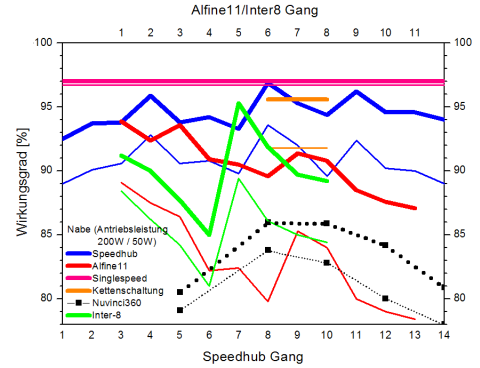
Under laboratory conditions (source: Fahrrad Zukunft), , a Rohloff already holds up well against the 97% efficiency of a standard derailleur transmission. Given that a dirty transmission will be closer to 94.5% efficiency, we can say that a clean Rohloff transmission is practically equivalent (source: CyclingAbout).